
Santa Maria delle Grazie has fourteen side chapels — seven on each side of the nave — each commissioned by wealthy Milanese families in the 15th and 16th centuries as private spaces for worship, patronage, and burial. Several contain frescoes by significant Lombard painters including Gaudenzio Ferrari. Entry to all side chapels is free and included in the standard church visit. No additional ticket or reservation is required.
The side chapels of Santa Maria delle Grazie are the most undervisited part of the complex. Most visitors walk the length of the nave focused on the crossing and Bramante’s apse, or are waiting for their Last Supper slot and don’t engage with the church at all. The chapels contain real art, real history, and — because they’re free and largely ignored — a level of quiet that is rare in any major Italian church.
Top Tickets
# Last Supper Guided Tour
# Last Supper Semi-Private Tour
# Last Supper + Milan Guided Tour
Table of Contents
The Chapel System: How It Worked
Each side chapel in Santa Maria delle Grazie was assigned to a wealthy Milanese family or guild, who paid for its construction, decoration, and maintenance. In return, the family held the right to use the chapel for private worship, to commission altarpieces and frescoes according to their devotional preferences, and to be buried within it. This patronage system was the primary means by which Italian Renaissance churches acquired their decorative programmes.
The chapels thus represent the private religious culture of 15th and 16th-century Milanese merchant and noble families — each one a window into a specific family’s theology, aesthetics, and social ambitions. The quality and elaborateness of each chapel’s decoration is a direct index of the patron family’s wealth and taste.
Gaudenzio Ferrari’s Frescoes
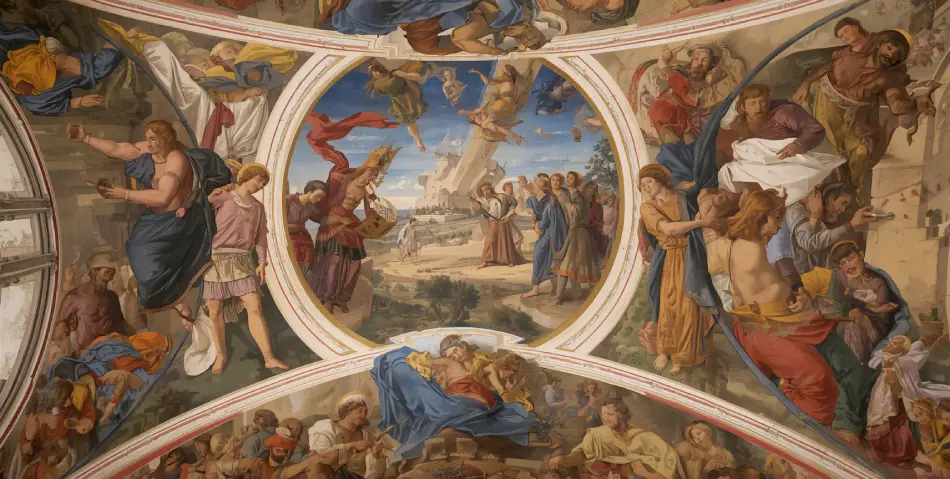
Gaudenzio Ferrari (c.1480–1546) painted frescoes in several of the side chapels at Santa Maria delle Grazie. Ferrari was one of the most significant painters working in Lombardy in the early 16th century — expressive, dynamic, and capable of an emotional intensity that distinguishes his work from the more restrained Milanese tradition. His figures are physically robust and emotionally present in a way that anticipates later Mannerist developments.
Ferrari’s work in the chapels is not widely known outside of specialist art historical circles, which means you can stand directly in front of significant early 16th-century fresco cycles with almost no other visitors present. This is the kind of encounter that is increasingly rare in Italian churches open to mass tourism.
Book This TourThe Chapel of St Catherine of Siena
The Chapel of St Catherine of Siena is among the most significant individual chapels in the church. St Catherine of Siena holds particular significance for the Dominican order — she is one of the order’s most important saints — and a chapel dedicated to her within a Dominican church carries special weight. The chapel’s decoration reflects Dominican theology and Sienese artistic influence.
The Noble Family Burials
Several of the chapels contain burial monuments and memorial inscriptions. The families who commissioned these chapels — Milanese noble and mercantile families prominent in the 15th and 16th centuries — are commemorated in stone, terracotta, and paint within the chapel walls. Walking through the side aisles is, among other things, a walk through the obituaries of Renaissance Milan.
How to Visit the Side Chapels
- All side chapels are accessible as part of the free church visit — no additional ticket required
- Walk both side aisles — the chapels on the north side (left as you enter) and south side (right as you enter) have different decorative programmes
- Bring a torch or use your phone’s torch — some chapels are poorly lit
- Visit during quieter hours (before 10 am or after 5 pm on weekdays) for the most peaceful experience
- The chapels are not accessible during Mass — check service times at the church entrance
What to Look For
As you walk through the side chapels, look for:
- Fresco fragments: Some chapels retain large sections of original fresco; others have only fragments surviving between later whitewash or renovations
- Altarpieces: Oil paintings on panel or canvas, mostly 16th and early 17th century, varying significantly in quality and condition
- Tomb slabs: Floor slabs with carved inscriptions marking burials beneath. Some are legible; others are worn smooth by centuries of foot traffic
- Family coats of arms: Heraldic decoration often appears in the vaulting or on the chapel walls, identifying the patron family
Frequently Asked Questions
Are the side chapels free to visit?
Yes. All fourteen side chapels are accessible as part of the free church visit. No separate ticket, reservation, or additional charge applies.
Who painted the frescoes in the side chapels?
Several chapels contain frescoes attributed to Gaudenzio Ferrari, a significant Lombard painter of the early 16th century. Other chapels were decorated by local Milanese painters of varying reputation. Art historical attributions for some chapels are still debated.
Can I photograph the side chapels?
Photography is permitted inside the church without flash. Individual chapels may have dim lighting — a phone torch helps see the details, but consider whether using a flash (which is not permitted) would improve the photo before trying.