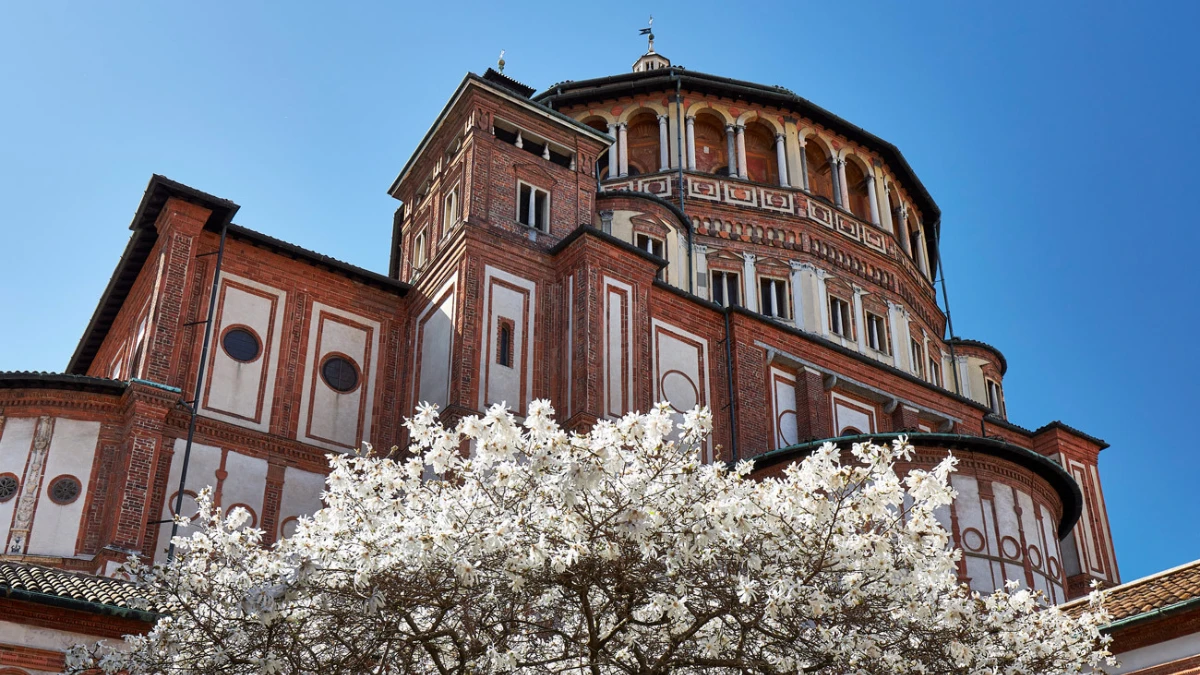
Santa Maria delle Grazie was built by Duke Francesco Sforza in the 1460s, later expanded by Donato Bramante under Ludovico Sforza, and designated a UNESCO World Heritage Site in 1980 — one of the few cases where both a building and a painting inside it share the same designation. Leonardo’s Last Supper is not a fresco but a tempera-on-dry-plaster mural, which is why it began deteriorating within decades of completion.
You probably know that The Last Supper lives here. You might know Leonardo painted it. But the stories behind this building — the near-destruction, the stolen masterpiece, the secret courtyard, the duke’s abandoned tomb — are the ones that make Santa Maria delle Grazie genuinely extraordinary.
Here are 12 facts that change how you look at the place.
Top Tickets
# Last Supper Guided Tour
# Last Supper Semi-Private Tour
# Last Supper + Milan Guided Tour
Table of Contents
1. It Started as a Small Chapel — Then a Duke Intervened
Santa Maria delle Grazie was founded in 1463 as a modest Dominican chapel. Duke Francesco Sforza of Milan ordered it demolished and replaced with a proper church and convent. Construction began the same year and was completed under his son, Galeazzo Maria Sforza, before Ludovico il Moro expanded it again in the 1490s.
What you see today isn’t the result of one grand vision. It’s the product of three generations of Sforza ambition. The Gothic nave was built first, followed by Bramante’s extraordinary Renaissance apse and dome — two completely different architectural languages, fused into one building. Explore the full history of Santa Maria delle Grazie.
2. Donato Bramante Designed the Most Important Part
In the 1490s, Ludovico Sforza commissioned Donato Bramante — one of the most important architects of the Italian Renaissance, later responsible for the first designs for St. Peter’s Basilica in Rome — to redesign the eastern end of the church.
Bramante’s addition is the apse, the tribuna (the drum beneath the dome), and the external cloister. His work transformed a modest Gothic church into a building that represents a pivotal moment in Renaissance architecture.
The contrast between the Gothic nave and Bramante’s Renaissance apse is visible the moment you walk inside. For a full architectural walkthrough, see our church interior guide.
3. The Last Supper Is Not a Fresco
Leonardo da Vinci painted The Last Supper in tempera and oil on a dry plaster wall — not using the traditional fresco technique of painting on wet plaster. He wanted more time to refine details, which the quick-drying fresco method didn’t allow. This decision gave him greater control but created a fundamentally unstable surface. The mural began deteriorating within 20 years of completion.
What you see today is largely the product of centuries of conservation work, with the most significant modern restoration completed in 1999 after 21 years of painstaking work. Our dedicated Last Supper painting guide covers the restoration history in full.
Book This Tour4. The Building Was Intended as a Royal Tomb — For a Dynasty That Never Made It
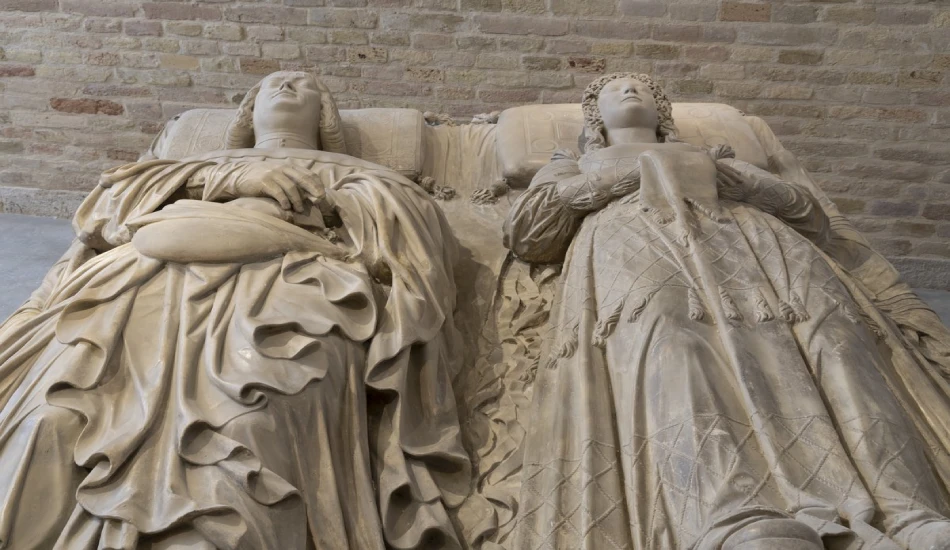
Ludovico Sforza’s plan for the church was personal. He commissioned Bramante’s expansion specifically to create a dynastic mausoleum — a resting place for the entire Sforza family.
The irony is that only Ludovico’s wife, Beatrice d’Este, was ever buried there — and then only briefly. She died in 1497 during childbirth, aged 21. Ludovico was captured by the French in 1500 and died in a French prison in 1508. Their tombs were later moved to the Certosa di Pavia.
5. A World War II Bomb Should Have Destroyed It

On 15 August 1943, a British aerial bombing raid hit the refectory of Santa Maria delle Grazie, destroying the roof and three of the four walls. The wall bearing The Last Supper remained standing, largely because it had been reinforced with sandbags, mattresses, and scaffolding as a precaution by museum staff who anticipated the raids. The mural survived by approximately 24 metres of distance from where the bombs fell.
The photographs from August 1943 are extraordinary: the refectory is open to the sky, rubble everywhere, and on the surviving north wall, The Last Supper intact. That it survived is not luck alone — the museum staff who packed the sandbags made a decision that changed art history.
6. There Is a Second Masterpiece on the Opposite Wall — That Nobody Talks About
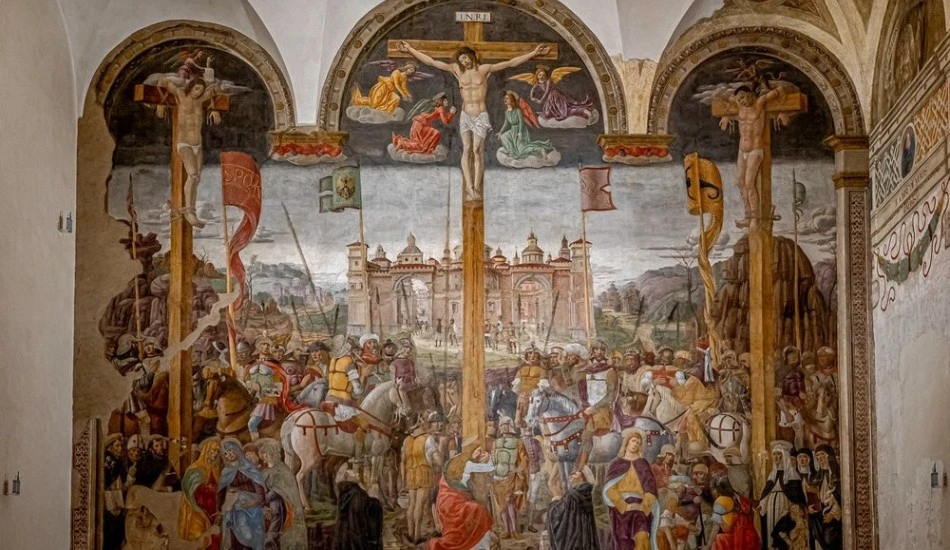
On the south wall of the refectory, directly facing The Last Supper, is The Crucifixion by Giovanni Donato da Montorfano, painted in 1495 in traditional fresco. Unlike Leonardo’s mural, Montorfano’s fresco has survived in excellent condition. It depicts the crucifixion of Christ with extraordinary detail — and is almost universally ignored by visitors who turn away from it to face The Last Supper.
When you enter the refectory, your natural instinct is to look straight at Leonardo’s mural. What most visitors never do is turn around. Behind them is Montorfano’s Crucifixion — a vibrant, emotionally intense 15th-century fresco that would be celebrated as a major work of art if it weren’t in the same room as one of the most famous paintings in the world. Read more in our Crucifixion by Montorfano guide.
Book This Tour7. Napoleon’s Troops Stole a Titian From Inside
Before the French armies arrived in Milan in 1796, the refectory contained a second major artwork: The Crowning with Thorns by Titian, one of the greatest painters of the Venetian school.
When Napoleon’s troops looted northern Italy’s churches and palaces, they took it. Today, Titian’s Crowning with Thorns hangs in the Louvre in Paris, where it has been since 1801. It has never returned.
8. The Side Chapels Were Private Family Property
Line the church nave and you’ll see chapels on both sides. Each was commissioned by wealthy Milanese families who effectively purchased their own private space inside the church for worship, display, and burial.
Each chapel was decorated according to the family’s taste and budget — some feature extraordinary frescoes that art historians consider significant but that most tourists walk past without a glance.
9. The Cloister of the Frogs Is One of Milan’s Best Hidden Secrets
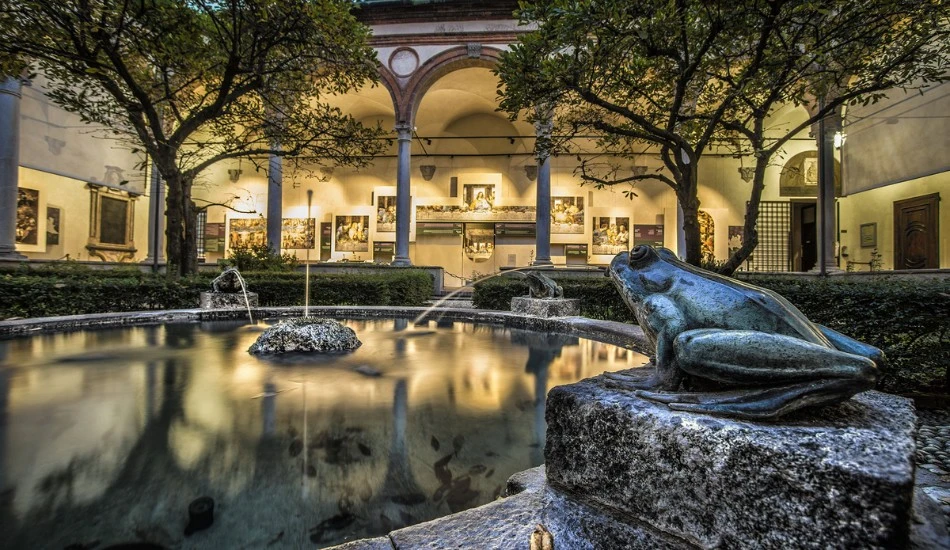
Behind the church, accessible through the convent, is the Chiostro delle Rane — the Cloister of the Frogs. It’s named after four small bronze frog sculptures placed around the central fountain. The cloister is peaceful, green, and largely unknown to tourists. It’s the perfect place to spend 15 minutes after the intensity of your timed museum visit.
Most visitors don’t know the Cloister of the Frogs exists. Those who find it consistently describe it as one of the most peaceful spots in central Milan. For directions and more detail, see our Cloister of the Frogs guide.
10. It’s a UNESCO Site for Two Different Reasons
In 1980, UNESCO designated Santa Maria delle Grazie a World Heritage Site. What’s unusual is that the designation covers both the architectural complex (Bramante’s church and apse, the cloister, the refectory) and The Last Supper painting itself.
This dual recognition is rare. Most UNESCO sites are designated for one primary reason. Santa Maria delle Grazie made the list because two Renaissance geniuses — Bramante and Leonardo — left major works on the same site, and both were deemed of outstanding universal value.
11. Leonardo’s Technique Includes a Perspective Illusion
Leonardo engineered The Last Supper as a visual extension of the room it’s painted in. The coffered ceiling in the mural appears to continue the actual ceiling of the refectory. The tapestries on the walls mirror the real walls. The table projects towards the viewer. The vanishing point aligns precisely with Jesus’s right temple — the mathematical and spiritual centre of the composition.
This was not accidental. Leonardo studied perspective obsessively and used it to make the painted scene feel spatially present in the room. For a full breakdown of the painting’s hidden details, geometry, and symbolism, see our Last Supper hidden details guide.
Book This Tour12. The Complex Was Originally Closed to the Public
For most of its history, the refectory and cloister were part of an active Dominican convent — not a public museum. The monks ate in the same refectory where The Last Supper was painted, with Leonardo’s mural as their dining room backdrop.
It was only during the 19th century, following the Napoleonic suppression of religious orders, that the convent was partially secularised and access to the refectory became possible for outsiders. The strict timed-entry system we know today was introduced in 1999 after the major restoration was completed.
Frequently Asked Questions
When was Santa Maria delle Grazie built?
Construction began in 1463 under the patronage of Duke Francesco Sforza. Donato Bramante expanded the church in the 1490s under Ludovico Sforza. The Last Supper was painted by Leonardo between 1495 and 1498.
Why did The Last Supper deteriorate so quickly?
Leonardo painted it in tempera and oil on dry plaster, rather than using the traditional fresco technique (painting on wet plaster). This gave him more artistic control but created an unstable surface that began peeling within 20 years. Humidity, pollution, and several ill-advised earlier restoration attempts accelerated the damage.
What does UNESCO protect at Santa Maria delle Grazie?
The UNESCO designation covers both the architectural complex (the church, apse, cloister, and refectory designed by Bramante) and Leonardo’s Last Supper painting. This dual designation — for both a building and a specific artwork inside it — is extremely unusual within the World Heritage system.
Is the Last Supper painting the original?
Yes. What you see in the refectory is the original mural, painted by Leonardo da Vinci between 1495 and 1498. It has undergone extensive restoration work, most recently completed in 1999, but it is not a reproduction or a copy.
Related Guides
- Leonardo’s Last Supper: The Painting Up Close
- Hidden Details and Secrets of the Last Supper
- The Crucifixion by Montorfano (The Other Refectory Fresco)
- History of Santa Maria delle Grazie
- What to See at Santa Maria delle Grazie