
Leonardo da Vinci lived and worked in Milan for approximately 18 years, from 1482 to 1499 and again from 1506 to 1513. Beyond The Last Supper, his Milan connections include: the Codex Atlanticus (the largest collection of his manuscripts, at the Biblioteca Ambrosiana), the Sala delle Asse ceiling fresco at Sforza Castle, the equestrian monument to Francesco Sforza (the clay model was destroyed, but the project is documented), and the Science and Technology Museum named after him.
Most visitors know that Leonardo painted The Last Supper in Milan. Fewer know that he spent the most productive two decades of his career in the city — working as court artist, engineer, architect, pageant designer, and scientist for the Sforza family. The evidence of that residence is scattered across Milan in ways that reward deliberate searching.
Top Tickets
# Last Supper Guided Tour
# Last Supper Semi-Private Tour
# Last Supper + Milan Guided Tour
Table of Contents
Leonardo and the Sforza Court: Why Milan?

Leonardo arrived in Milan in 1482, probably at the age of 30, bearing a letter of introduction to Ludovico Sforza that emphasised his military engineering capabilities rather than his painting. The letter — which survives in partial draft form — lists his abilities as a designer of bridges, siege weapons, armoured vehicles, and cannon, with painting mentioned almost as an afterthought.
The Sforza court needed a versatile polymath who could contribute to both the military and the cultural projects of an ambitious duchy. Leonardo remained in Milan’s service until the French invasion of 1499, when Ludovico was captured and Leonardo left the city.
The Codex Atlanticus: Biblioteca Ambrosiana

The Codex Atlanticus is the largest surviving collection of Leonardo da Vinci’s manuscripts and drawings — 1,119 pages covering approximately 50 years of his working life, from 1478 to 1519. It is held at the Biblioteca Ambrosiana in Milan and contains drawings of machines, anatomy, architecture, botany, geography, and a wide range of scientific investigations. Selected pages are on public display in the Pinacoteca Ambrosiana adjacent to the library.
Where: Pinacoteca Ambrosiana, Piazza Pio XI, Milan — approximately 15 minutes on foot from the Duomo
What you can see: Selected facsimile pages from the Codex on display in the Pinacoteca. The originals are in the library and not generally accessible to the public.
Also at the Ambrosiana: Leonardo’s Portrait of a Musician, one of only four surviving panel paintings universally attributed to Leonardo, is in the Pinacoteca Ambrosiana’s permanent collection.
The Sala delle Asse: Sforza Castle
The Sala delle Asse (Room of the Boards) in Sforza Castle contains a ceiling fresco attributed to Leonardo da Vinci — a trompe l’oeil of interlaced trees and foliage, painted around 1498–99. The attribution to Leonardo is long-established but the fresco was heavily repainted in the early 20th century; ongoing restoration work has revealed what art historians believe are original Leonardo sections beneath the later additions.
Where: Castello Sforzesco, Piazza Castello, Milan — 12 minutes on foot from Santa Maria delle Grazie, or 15 minutes from the Duomo
Access: The Sala delle Asse may have restricted access during ongoing restoration work. Check the Castello Sforzesco website for current status before visiting.
The Museo Nazionale della Scienza e della Tecnologia
Milan’s National Museum of Science and Technology bears Leonardo da Vinci’s name. It houses an extensive collection of models based on Leonardo’s designs — machines, hydraulic systems, anatomical studies, flying machines — built over the past century from his drawings in the Codex Atlanticus and other manuscripts.
Where: Via San Vittore 21, Milan — approximately 10 minutes on foot from Santa Maria delle Grazie
Note: The models are reconstructions, not originals. The museum is engaging for those interested in Leonardo’s engineering designs; it is not an art museum.
Book This TourLeonardo’s Milanese Studio and Residence
Documentary evidence indicates that Leonardo maintained a residence and studio in the Porta Vercellina area of Milan — the same district as Santa Maria delle Grazie. The exact location of his studio is not definitively identified and no structure associated with him survives. The Magenta neighbourhood that now surrounds the church is the approximate area of his residence.
The Sforza Horse: The Lost Monument
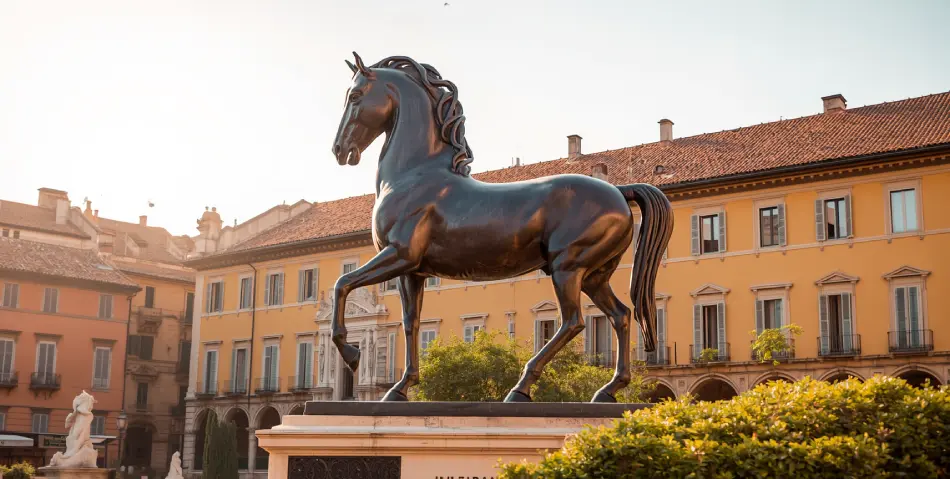
One of Leonardo’s most ambitious Milanese projects was the equestrian monument to Francesco Sforza, commissioned by Ludovico to honour his father. Leonardo worked on designs for the horse — which was to be the largest bronze equestrian statue ever cast — for over 15 years. A clay model was built at full scale. It was destroyed in 1499 when French archers used it for target practice after the invasion. The bronze intended for the casting was melted down for cannons.
The project exists only in Leonardo’s surviving drawings and contemporary accounts. In 1999, the American sculptor Nina Akamu completed a bronze horse based on Leonardo’s designs; it stands in Milan outside the Ippodromo.
Frequently Asked Questions
How long did Leonardo live in Milan?
Leonardo lived and worked in Milan for two periods totalling approximately 18 years: 1482–1499 (his first and most productive Milan period, during which he painted The Last Supper), and 1506–1513 (a return period during which he worked on other projects).
What other Leonardo works can I see in Milan?
The Portrait of a Musician at the Pinacoteca Ambrosiana is the only other universally attributed Leonardo panel painting in Milan. The Sala delle Asse ceiling fresco at Sforza Castle is attributed to Leonardo with high confidence. The Codex Atlanticus pages on display at the Ambrosiana are original manuscript pages in Leonardo’s own hand.
Is the Leonardo da Vinci Science Museum worth visiting?
For visitors specifically interested in Leonardo’s engineering designs and scientific investigations, yes. For those primarily interested in the art and painting, the Pinacoteca Ambrosiana is more rewarding. The Science Museum models are fascinating but secondary to the original works.